When sex hurts and you've learned not to say so
Endometriosis, sex and the version of yourself you had to leave behind
Let's start with something that gets said way too rarely: endometriosis is not 'bad periods'. It is a systemic, chronic condition where tissue similar to the uterine lining grows outside the uterus: on ovaries, fallopian tubes, the bowel, the bladder, and sometimes on other organs too. It causes pain that can be genuinely debilitating. And it takes an average of eight years to diagnose in the UK.
Eight fucking years.
Eight years of being told it's normal for periods to hurt this much. Eight years of being offered painkillers, the pill, and a vague hint that your tolerance or coping skills might need some work. Eight years of learning, in the most authoritative settings available, that your experience of your own body is probably a bit much.
Male pattern baldness gets six times more research funding than endometriosis. Let that one sit for a second.
I'm a therapist. I'm also someone who has lived inside this particular experience. And what I want to talk about, because almost nobody does, is what eight years of medical dismissal does to a woman. Not just to her body, but to her relationship with herself. And specifically, to her intimate relationships and her sexuality.
If you've ever found yourself wondering why you don't enjoy sex anymore and suspecting it might be connected to something much bigger than the bedroom, this is for you.
Why you go through the motions during sex (and why it's probably not about sex)
Going through the motions. Just getting on with it. Being there but not really being there.
If you have endometriosis, PMDD, or any chronic condition that has been minimised or handed back to you as a personal management problem, you probably know exactly what this feels like. You've probably been doing it for years, in multiple contexts. And chances are you are absolutely brilliant at it.
In the bedroom, it might look like this: you're present enough that nobody would know. You're tracking what's needed, what's working, whether this is going okay. You're managing around the parts that hurt, or the parts where you've just switched off, without making it a thing. You're doing it so well that your partner probably has no idea. Sometimes you barely notice yourself.
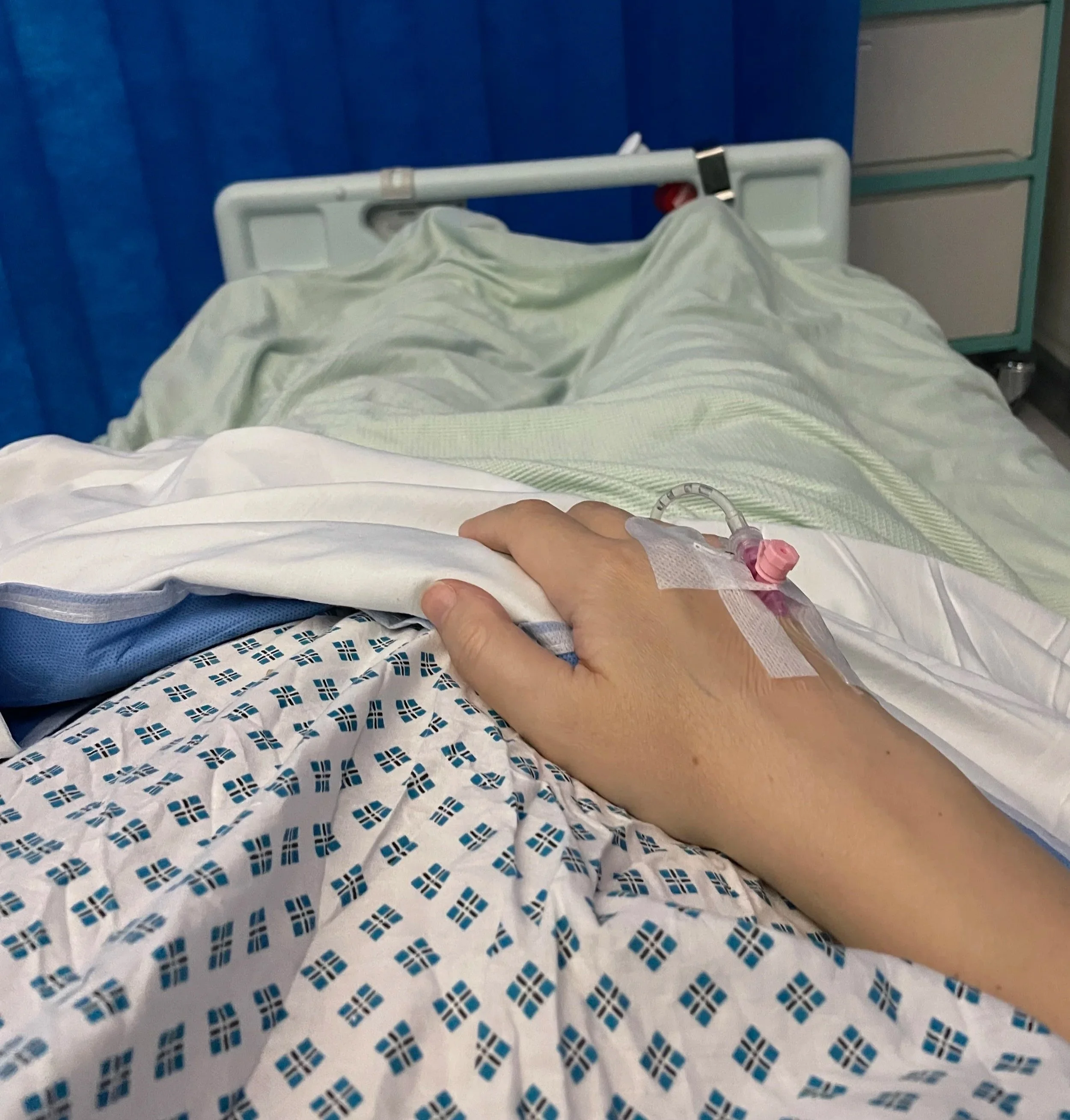
Post-endo surgery
Eight years average diagnosis time in the UK.
Six times less research funding than male pattern baldness.
But sure, it's probably just bad periods 👀
This is what years of medical dismissal actually produces: not just a woman who pushes through pain, but a woman who has learned to leave her own body and call it coping.
When you spend years being told that what you feel isn't quite as serious as you think, you don't just update your beliefs about pain. You update your beliefs about yourself. You learn to override your inner experience in favour of functioning. You learn that saying “I'm not okay” is rarely worth the energy, because it hasn't historically led anywhere useful.
And that learning, that deeply practised, entirely understandable skill of separating your inner experience from your outer performance, doesn't stay contained to medical appointments.
It moves into your relationships, into your bed and into who you let yourself be when intimacy asks something of you.
Medical gaslighting and relationships: the connection nobody talks about
Medical gaslighting is what happens when you repeatedly present with a real, physical experience and are told by people with authority and credentials that it's probably not as bad as you think. That it's normal. That other women manage. That it might be stress, anxiety or your relationship with pain.
The cumulative effect of this is not just frustration or distrust of the medical system. It's a specific kind of internal reorganisation. You start to apply that same dismissiveness to yourself. You become your own gaslighter by overriding, minimising or pre-empting the dismissal by doing it first, to yourself, before anyone else gets the chance.
I see this in the women I work with, both in private practice and in the years I spent working in women's centres and custodial settings, where the gap between women's actual experience and what they felt allowed to talk about was often huge. The body gets disbelieved first and from there, the logic of self-erasure spreads:
“If my pain isn't real, maybe my anger isn't either”.
“Maybe my fear is an overreaction”.
“Maybe what I experience as too much is just me being difficult”.
This isn’t a personal failing. This is a completely predictable response to a medical culture that for decades has treated women's pain as psychological until proven otherwise, and a culture around sex that often follows the same script. Endometriosis and mental health are deeply connected, not because the condition is psychological, but because of what years of dismissal do to a woman's relationship with her own inner life.
Why endometriosis kills your sex drive
Intimacy and desire need presence. Not just physical presence, but the kind where you are actually inside your own experience and connected to what your body is doing and what it wants. That kind of presence is incredibly hard when your default mode is to manage around your body rather than be in it.
A lot of the women I work with who have endometriosis or PMDD describe a version of the same thing: desire that feels distant, or performative, or simply missing in a way they can't fully explain. They're not necessarily unhappy in their relationships, they might be with someone genuinely good. But something in the intimate dimension has gone quiet, and they can't work out why, and they've started to wonder if something is wrong with them.
Nothing is wrong with them.
What's happened is that the same self-protective split they learned to manage their physical experience (the one that says 'stay functional, don't fully feel this') has spilled into into their sexuality. And here's the thing about desire: it needs you to actually be there. If you've spent years practising not being fully in your body, your desire doesn't get a special exemption from that.
“Endometriosis and PMDD are conditions that are chronically under-researched and under-funded because they affect women. The dismissal you experienced was not a reflection of your credibility. It was a reflection of whose pain gets taken seriously.”
How chronic pain changes who you are in relationships
Chronic pain and relationships are entangled in ways that rarely get named. One of the things that comes up again and again in therapy with women who carry this history is grief. Not always named as a loss, but present in the room as a kind of quiet bewilderment: who would I be if I hadn't spent so long managing?
There's a version of you that existed before the override became automatic. Before you got good at separating your experience of sex from your performance of it, and before sex became something you navigated rather than something you were actually in, and maybe even enjoyed.
That version of you didn't go anywhere, but she did go quiet. She learned that being fully present in her own experience wasn't safe: not in the doctor's office, not always in the bedroom, not in relationships where her needs had a habit of being too much or poorly timed or just not as important as keeping things okay.
Losing yourself in relationships is what happens when the override becomes your default, not just physically, but emotionally. You manage around your needs, your desire, your dissatisfaction in the same way you learned to manage around your pain.
Getting back to her isn't about fixing your libido or improving your communication or doing the things the wellness industry will try to sell you. It's slower and more fundamental than that. It's about learning, probably for the first time in a long time, that your inner experience is worth occupying. That your body is trustworthy. That desire isn't something you perform for other people. It belongs to you.
Working with endometriosis and relationship patterns in therapy in Surrey and online
I want to be upfront: this isn't a quick fix.
When self-erasure has been conditioned across medical, relational and intimate contexts for years, it doesn't shift because you've understood it. Insight is useful, but it's not sufficient.
What actually shifts things is doing the work in a relational context where you can start to notice in real time when you've left your own experience or gone into management mode. And where, gradually, it becomes possible to stay a bit longer. To tolerate being fully known. To let your desire for connection, pleasure and your own life actually mean something.
That's what the psychodynamic work I do is oriented towards. It’s not about symptom management or communication scripts. It’s the deeper thing: helping you find your way back to a self that hasn't been overridden.
If your body has been the thing you've had to manage around - in the doctor’s office and in the bedroom - this is exactly the work I do. I offer psychodynamic, relational therapy in Bisley, Surrey, in person near Woking and Guildford, and online therapy for women across the UK. If endometriosis, chronic pain, or PMDD has shaped how you show up in relationships and in your own body, this is work I understand from the inside as well as the clinical room. If this resonates, I'd love to hear from you.